
DIGITAL INFORMATION - Intro to Binary
OPENING QUESTION: What is the purpose of a computer programming language?
OBJECTIVES: During today's class I will be able to:
- represent decimal numbers using combinations of binary (base 2) digits 0 and 1
- represent binary numbers using combinations of decimal (base 10) digits 0-9
- explain how the position of each binary digit determines its place value and numeric value
WORDS FOR TODAY:
I STRONGLY URGE YOU TO START A DECK OF FLASH CARDS HERE
- innovation: "A new or improved idea, device, product, etc, or the development thereof
- prototype: "A proof of concept"
- CPU: Central Processing Unit
- Binary: 0's & 1's
- Byte: one binary 'word'
- Bit: one binary 'letter' - either a 0 or 1
WORK O' THE DAY:
We didn't *quite* make it this part of last Friday's plan so let's begin here!
Back to binary....
Soooo, once again let's talk binary.
Binary is the way that computers process data by reading a series of 0's and 1's.
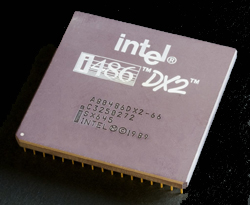
All programming instructions, all data, all input MUST be converted into 0's and 1's in order to be processed by a computer (our laptops have a integrated circuit chip CPU - Central Processing Unit) that does the chore:
Humans don't work in binary very well... it is very hard to read and at least as hard to write.
So we create programming languages that we *can* read and write much more easily.
Those programs are then usually "compiled" into binary so the computer can execute them.
Please have a conversation with your crew.... why binary? Why did early computer scientists choose to use something so difficult to communicate with computers?
═══════════════════════════
Soooo.... we have to learn the basics of binary
Let's do that now:
Please take a copy of this from the back table.
Work with your group to construct a 'Flippy Do'. Instructions are HERE (It may seem a little weird, but hang tough, you'll get it!)
You WILL be tested on your knowledge of binary, octal (a bit less) and hexadecimal on the AP test...
Work with your group to see if you can develop an 'algorithm' (method) to convert numbers from decimal into binary and binary into decimal.... HINT: we'll start SMALL
Convert the following from decimal to binary using your "flippy do"
- 25
- 119
- 6
- 1
Now let's work the other direction and go from binary to decimal
- 00101000
- 10101000
- 00111000
- 10101010
Let's spend some time practicing to and from binary:
- Binary 'words' are almost always represented in terms of 1 byte. 1 byte = 8 binary 'bits'
═══════════════════════════
If time permits we'll discuss the pro's and cons of "Octal" and "Hexadecimal"